
What is Larder Section?
- It is the Cold Kitchen or that part of the kitchen department which is set aside for the storage and preparation of perishable foods- both raw and cooked.
- The food stuffs such a meats, fish, poultry, and game, vegetables other perishables are prepared and made ready for cooking.
- All the cold foods found on the menu such as appetizers ( Hors d’ oeuvres ), cold fish or meat dishes , all salads, cold sauces and dressings are made ready.
- One particular special duty of this department is the preparation of all types of cold buffet- a major feature of many functions and banquettes.
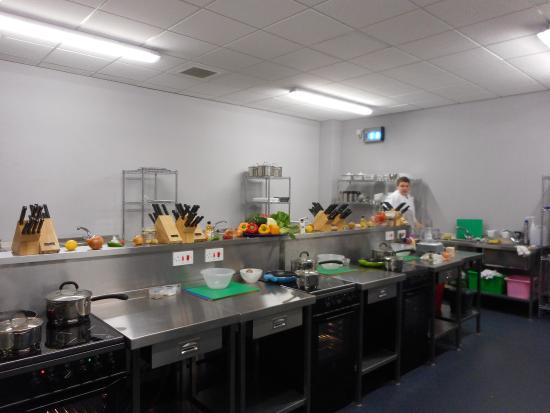
For effective departmental functions
- This section is separate from the main kitchen and located in a cool place. At the same time it should be close to the kitchen to avoid undue traffic and time wastage between the other kitchens.
- It should be light, well ventilated and spacious to allow the staff to carry out their duties in a clean and efficient manner.
- It must also be able to store prepared foods and buffets in a cool and hygienic manner.
- It must be equipped with necessary fittings, plant, machinery and tools in accordance with the volume of the business
Sections of Larder
The work is broken down into various sections-
- Appetizer section
- Salad and dressing section
- Butchery
- Cold buffet
In large busy establishments, there is a full team of workers to carry out the above functions. The butcherer, poultrer or the fishmonger may be an expert in their own fields. These duties are allocated by chef garde manger, who is the overall charge of the department, to commis or assistant chefs. These are known as commis garde manger. The team will depend on the volume of the business.
Duties and responsibilities of chef Garde manger
- Efficient working of the larder section.
- Co-ordination for the efficient running of the garde manger.
- Training of the larder staff
- Maintaining discipline of the section.
- He is responsible for all the foodstuffs which are dealt in the section especially all the cold food and their proper storage.
- He is responsible for keeping the record of the entire foodstuff coming into the section and the orders served to the main kitchen and the other outlet kitchens.
- The chef needs to put in the requisition for the meats, fish and poultry and other food ingredients required for all the food service.
- He is responsible for maintaining his section in the best of hygienic and sanitary conditions to avoid any danger of contamination and possible food poisoning.
Layout of Larder Section
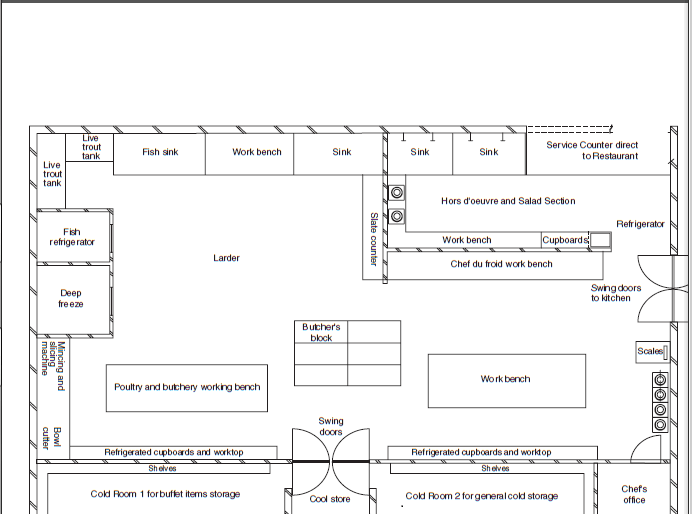
Larder of a 5 star operational kitchen will be segregated into the following section
- Hors d’oeuvres and salad section having two sinks, work tables, storage racks and cupboards, refrigerator, gas range, and pickup counter.
- Poultry and Butchery section with a butcher’s block, work table, refrigerators, deep freeze, mincing and slicing machine, sinks.
- Fish section having live fish tanks, two sinks, work tables, refrigerator, deep freeze.
- A general section with work tables.
- Cold rooms with deep freezer and walk-in facility 6. A weighing scale next to the entrance.
- Chef’s office
Larder Control
To operate the department efficiently and economically, it is essential that the chef garde manger should exercise strict control over the foodstuffs received and stored in the department. This involves
- Checking the quality and quantity delivered to the larder.
- Ensuring that all foodstuffs are stored at the right temperatures and that they can be easily checked.
- Ensuring that the food is protected from contamination and vermin.
- Ensuring that portion control is rigidly carried out. A given weight of fish, poultry, meat
- should always produce the standardized portions.
- Ensuring that the food is never overstocked and stocks of food are regularly turned over.
- Taking all precautions to ensure there is no pilferage.
- Taking the daily stock of the food material stored in the larder section.
- Making every effort to maintain the highest possible standards of hygiene.
Larder Equipments
MINCING MACHINE AND FOOD PROCESSORS
- These two machines have an important function in the larder. The mincer is used for the mincing of raw meats for sausages, hamburgers, meat loaves, mincing of fats prior to rendering for dripping.
- A food processor is a useful tool in the mixing of the raw and cooked farces, pates, mousses and puree mixtures as well as some sauces. It is also handy for the making of breadcrumbs from the day old breads.
- These metal machines are quite expensive and should be robust for heavy duty for commercial use.
- The mincing and the processor attachments can be dismantled for cleaning which should be done with hot water containing grease solvents, then rinsed and dried before re-assembling.
- The machine needs to be lubricated at regular intervals with the lubricating oil. • The operator should study the instruction manual to become familiar with the oiling points.
THE SLICING MACHINE
- Is used for cutting slices of cooked meats such as ham or tongue, or any other boneless joints of meat.
- It is also used for cutting bacon or gammon rashers.
- A calibrated scale is fitted to determine the thickness of the slices.
- They may be hand-operated, semi-automated or fully automatic.
- The cleaning of the machine should be done carefully following the instructions on the manual. No food should be left clinging to the parts which cannot be removed for cleaning as the bacterial growth will occur.
- The blades should be kept sharp always using the grindstone attachment provided along.
- The machine should be kept lubricated with the oil provided.
SCALES AND WEIGHING MACHINES
- There are various types of weighing scales- large platform scales for weighing large meat joints. There are graduated scales fitted with a price chart showing the prices at a glance.
- No maintenance is necessary other than keeping them clean and hygienic. Sponging them with a cloth soaked in hot water and then drying thoroughly will do the needful. The pans of the smaller scales should be removed and washed well in hot water.
- Foodstuff should not be placed directly onto the platform or the pans of the scales but should be kept in some container or trays or a sheet of greaseproof paper when being weighed.
ELECTRIC GRINDING MACHINE
- This machine is used for grinding an edge on knives and choppers or cleavers. It should be used if only the carborundum stone fails to set an edge. Frequent use will wear the knives and the choppers down very fast.
- Make sure that there is sufficient water in the well and the grindstone is wet while the sharpening takes place.
- Keep the machine clean.
- Lubricate the machine as per the instructions in the manual.
BOILING PLATE OR GAS RINGS
- These are used to heat or cook as required such as cooking the vegetable hors d’oeuvres, for rendering fats, making aspic jelly , sauces, pickles and other larder preparations.
- Spilling or boil overs should be wiped and cleaned with warm water and soap solution. The burners need to be cleaned on the periodical basis.
- The enamelled parts of the surrounding should be sponged down with water. Abrasives should not be used as they damage and scratch the enamel.
SALAMANDER / GRILL / TOASTER
- These are used for grilling or toasting many foodstuffs for making savouries and canapés and for grilling sausages etc.
- For cleaning the burners should be lightly brushed to prevent the holes from clogging. The metal reflectors should be wiped on a regular basis.
- The fat drip tray must be emptied and cleaned daily. A little water in the tray will help the grease from baking on. Do not allow the crumbs to burn in the tray .
- The enamel parts must be wiped with a damp sponge on a daily basis.
BUTCHERS’ BLOCKS
- These are used in the butchery for jointing and cutting meats.
- They have the advantage of being reversible. They can also be re-serviced when badly worn out by sawing at the timber yard.
- A good general rule is to keep the surface as clean and dry as possible and should be washed well and drained and dried after each use.
SAUCEPANS AND LIDS
- They are mostly stainless steel or aluminium or latest can also be hard anodized. They require utmost care for maintaining them clean.
- They should be washed in warm soapy water and dried well after use.
TABLES, COUNTERS AND FLOORS
- Steel tables are used as work tables. Always keep them clean and never use their surface for chopping or cutting as the damage can be two ways.
- Chopping boards which are color coded are used for this purpose.
- The tables should be cleaned by sponging with hot soapy water and rinsed with warm water and then dried after use.
- At the end of each session, the sinks, the counters and the floors must be well cleaned .
REFUSE BINS
- The waste bins should be lined with disposal bags and be emptied on the daily basis.
- The bins should be stored in air conditioned temperature as they store lot of perishable wastes.
- They should be thoroughly cleaned, inside out, on the daily basis.
Other larder tools
Other small equipment required in the larder section are-
- Serving spoons and ladles
- Sieves
- Colanders
- Conical strainers
- Meat presses
- Pie moulds
- Whisks
- Egg slicers
- Steel basins
- Graters
- Cutlet bat
- Trussing needles
- Larding needles
- Larding pin
- Lemon zesters
- Vegetable scoops
- Butchers hooks
- Skewers
- Brinometer
 Sarav
Sarav 