
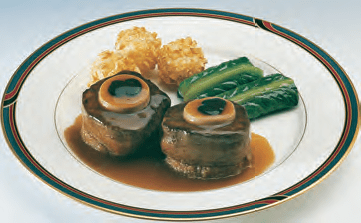
The word garnish is derived from a French word meaning “to adorn” or “to furnish.” In English, we use the word to mean “to decorate or embellish a food item by the addition of other items.” The word is used also for the decorative items themselves.
This definition, at first, seems vague because it could include just about anything. To
many people, the word garnish means a sprig of parsley haphazardly placed on the plate. Just as common is the practice in some restaurants of adopting a single garnish and using it routinely on every plate, from prime rib to batter-fried shrimp. No one garnish is appropriate for every plate, just as no one side dish is appropriate for every plate. In fact, the term garnish has been used for a great variety of preparations and techniques in the history of classical and modern cuisines. Today, the use of parsley sprigs on every plate has become rare, and we are again using the word garnish in a more traditional way
Classical Garnishes
In classical cooking, the terms garnish and garniture have been used the way we use the
term accompaniments. In other words, garnishes are any items placed on the platter or plate or in the soup bowl in addition to the main item. It happens that these accompaniments also make the food look more attractive, but that is not the emphasis.
The classical French chef had a tremendous repertoire of simple and elaborate garnishes, and they all had specific names. A trained chef, or a well-informed diner, for that matter, knew the word Rachel on the menu meant the dish was served with artichoke bottoms filled with poached marrow, and Portugaise meant a garnish of stuffed tomatoes.
There were so many of these names, however, that no one could remember them all. So they were catalogued in handbooks to be used by chefs. Le Répertoire de la Cuisine, first published in 1914 and one of these handbooks, has 209 listings in the garnish section alone, not to mention nearly 7,000 other preparations, all with their own names. The garnishes may be as simple as the one called Concorde or as complex as the one called Tortue, quoted here to give you an idea of the complexity and elaborateness of classical garnish.
Concorde (for large joints)—Peas, glazed carrots, mashed potatoes.
Tortue (for Entrées)—Quenelles, mushroom heads, gherkins, garlic, collops of tongue
and calves’ brains, small fried eggs, heart-shaped croutons, crayfish, slices of truffles.
Tortue sauce.
Many of the classical names for garnishes are still used in modern kitchens, although they have lost the precise meanings they once had. You will encounter some of these terms in your career, so it is worthwhile learning them.
- Bouquetière: bouquet of vegetables
- Printanière: spring vegetables
- Jardinière: garden vegetables
- Primeurs: first spring vegetables
- These four terms refer to assortments of fresh vegetables, including carrots, turnips,
- peas, pearl onions, green beans, cauliflower, sometimes asparagus, and artichokes.
- Clamart: peas
- Crécy: carrots
- Doria: cucumbers (cooked in butter)
- Dubarry: cauliflower
- Fermière: carrots, turnips, onions, and celery, cut into uniform slices
- Florentine: spinach
- Forestière: mushrooms
- Judic: braised lettuce
- Lyonnaise: onions
- Niçoise: tomatoes concassé cooked with garlic
- Parmentier: potatoes
- Princesse: asparagus
- Provençale: tomatoes with garlic, parsley, and, sometimes, mushrooms and/or olives
- Vichy: carrots
Modern Hot Platter Garnish
In classical cuisine, food was nearly always brought to the dining room on large platters and then served, rather than being plated in the kitchen, as is most often done today.
Although this practice is not nearly as common as it was a few decades ago, it is still
sometimes used for banquet service, and nothing stimulates appetites as much as a succulent roast on a silver platter, sumptuously adorned with a colorful variety of vegetable garnishes.
The classical garnitures most often adapted to modern platter presentation are those
called bouquetière, jardinière, and printanière. At one time, these were specific vegetable assortments cut in prescribed ways. Today the terms are taken in a more general way indicating colorful assortments of fresh vegetables.
Platter garnish need not be elaborate or difficult to prepare. A simple assortment of colorful vegetables, carefully cut and properly cooked to retain color and texture, is appropriate to the most elegant presentation. Stuffed vegetables, such as tomato halves filled with peas, are a little fancier, but still easy to prepare. Borders of duchesse potatoes are also popular Many of the rules of proper plating apply to platter arrangement as well—for example, those that call for neatness, balance of color and shape, unity, and preserving the individuality of the items.
Following are a few more guidelines that apply to hot platter presentation and
garnish.
- Vegetables should be in easily served units.
In other words, don’t heap green peas or mashed potatoes on one corner of the platter. More suitable are vegetables such as cauliflower, broccoli, boiled tomatoes, asparagus spears, whole green beans, mushroom caps, or anything that comes in large or easyto- handle pieces. Small vegetables such as peas can be easily served if they are used to fill artichoke bottoms, tomato halves, or tartlet shells. - Have the correct number of portions of each item.
Vegetables like Brussels sprouts and tournéed carrots are easily portioned in the dining room if they are arranged in little portion-size piles. - Arrange the garnishes around the platter to get the best effect from the different colors and shapes.
The meat, poultry, or fish is usually placed in the center of the platter, or in a row or rows, and the garnishes arranged around it. - Avoid being too elaborate.
While it is sometimes desirable to make ornate platters, simplicity is usually preferable to an overworked appearance. Let the attractiveness of the food speak for itself. The garnish should never dominate or hide the meat, which is the center of attention. - Serve extra sauce or gravy in a sauceboat.
If it is appropriate, dress or nap the meat or fish items with some of the sauce, but don’t drown the entire platter with it. - Serve hot foods hot, on a hot platter.
Don’t spend so much time arranging the food that it’s cold by the time it reaches the dining room.
Suggested Garnishes
Garnishes for foods and entrees include:


- Amandine – a culinary term indicating a garnish of almonds
- Caviar
- Chives
- Crouton
- Duxelles
- Fried onion – used as a garnish on steaks and other foods
- Gremolata
- radish
- Manchette
- Microgreens – young vegetable greens that are used both as a visual and flavor component, ingredient and garnish
- Mint
- Nuts
- Olive oil – drizzled olive oil is used to garnish some foods
- Ginger
- Parsley
- Persillade
- Sautéed mushrooms – used on steaks and other foods
- Edible seaweed – used to garnish foods such as soups, entrees and sashimi
- Sesame seeds
- Walnut
- ginger
Garnishes for desserts and sweets include:

- Cocoa powder
- Flaked coconut
- Confetti candy
- Coulis
- Edible flowers
- Sliced fruit
- Gomul
- Maraschino cherry
- Mint
- Sprinkles
- Vark
- Wafer
- Nuts
- Walnut pieces and candied walnuts
- Wedding cake topper
Garnishes for beverages:

- Cocoa powder
- Cocktail garnish
- Cocktail onion
- Cocktail umbrella
- Green olive
- Mint
- Twist
Soup garnishes:
Classic French garnishes include
.jpg)
- Brunoise – one to three mm diced vegetables
- Chiffonade – finely shredded lettuce or sorrel stewed in butter
- Croutes – small pieces of halved French bread buttered and oven dried
- Coulis – (a thicker soup) drizzled decoratively
- Croutons – small pieces of bread (typically cubes) fried in butter or other oil
- Julienne – thinly sliced vegetables
- Pasta (tapioca, sago, salep) etc.
- Pluches – a whole leaf spray of herbs, without the central stalk (traditionally chervil)
- Profiterolles – puff pastry stuffed with purée
- Royale – a small decoratively shaped piece of egg custard (in German this is called an Eierstich)
- Threaded eggs
- For relevés and entrées:
- Croquettes
- Potatoes (pommes dauphine, Duchess potatoes or Marquis)
- Duxelles – fried onion, mushrooms and herbs
- Matignon – minced carrots, onions, and celeries with ham stewed in butter and Madeira
- Mirepoix – similar to Matignon but diced (cf. minced) with or without ham (or with bacon substituted for the ham)
- Salpicon – a variety of other diced meats or vegetables
- Fritters

